ISO 19650 Changes Explained (2026 Update): Is BIM Being Replaced by Information Management?
The construction industry is entering a pivotal moment, as the latest ISO 19650 changes begin to reshape how projects are delivered and managed.
Draft revisions to ISO 19650 Parts 1, 2 and 3, released for public consultation in 2026, signal one of the most significant shifts in digital construction standards since BIM became mainstream.
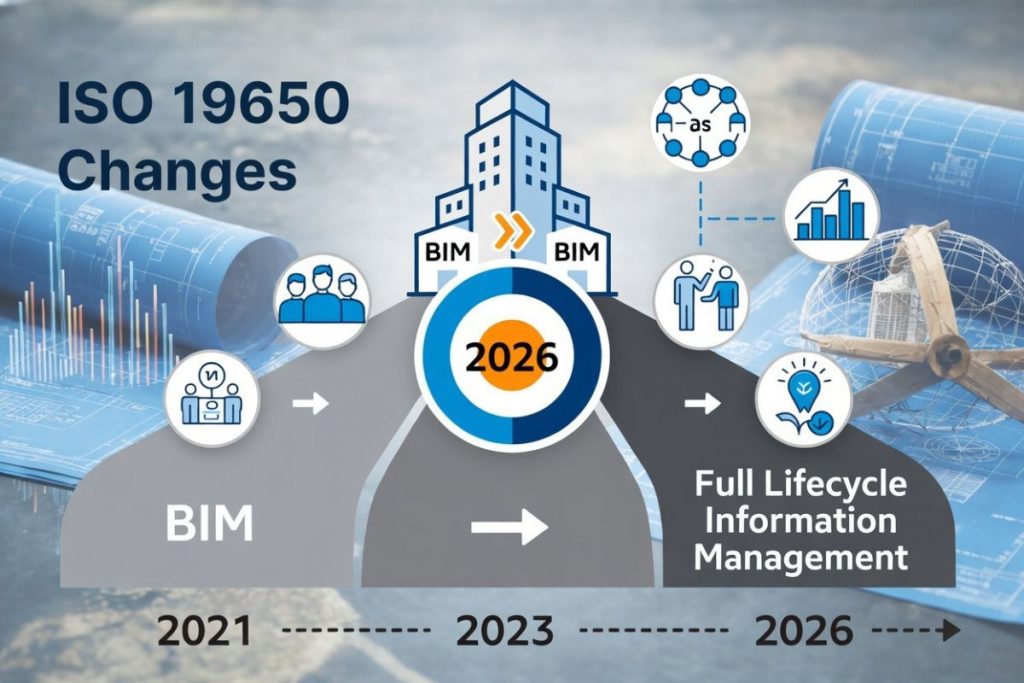
While BIM (Building Information Modelling) has dominated industry language for over a decade, the proposed ISO 19650 changes point towards something broader:
a transition from “BIM” to full lifecycle Information Management (IM).
This is not just a terminology update. It represents a fundamental evolution in how construction projects are planned, delivered and operated.
In this guide, we break down what’s changing, why it matters and what the ISO 19650 changes mean for organisations preparing for the next generation of digital construction.
It is important to note that these ISO 19650 changes are currently part of a Draft International Standard (DIS) released for public consultation. The existing 2018 editions remain in force, and the final structure will depend on industry feedback and international consensus.
Why ISO 19650 Is Being Updated
ISO standards undergo a systematic review approximately every five years to ensure they remain relevant and effective.
Following the latest review cycle, national standards bodies agreed that ISO 19650 Parts 1 and 2 required revision, with Part 3 also brought into scope due to its close relationship.
An international working group of industry experts has since been developing updated drafts, incorporating:
- Lessons learned from global BIM adoption
- Industry feedback since the original release
- The growing importance of operational data and asset lifecycle management
These ISO 19650 changes are designed to reflect how projects are actually delivered today — and more importantly, how they will be delivered in the future.

The Big Shift: From BIM to Information Management
One of the most talked-about ISO 19650 changes is the shift in language.
Across the draft revisions, there is a clear movement away from BIM-specific terminology towards a broader Information Management (IM) approach.
This includes:
- BIM → Information Management (IM)
- EIR → IPR (Information Production Requirements)
- BEP → IPP (Information Production Plan)
- MIDP / TIDP → IPS (Information Production Schedule)
This shift reflects a deeper industry realisation:
The goal is no longer just creating digital models — it is managing information effectively across the entire asset lifecycle.
BIM helped digitise design and coordination.
Information Management enables clarity, continuity and decision-making from concept through to operation. In practice, this increasingly depends on how organisations combine Common Data Environments with mobile workflow apps to manage both controlled information and site-based activity.
What Are the Key ISO 19650 Changes in 2026?
The proposed ISO 19650 changes introduce several important structural and conceptual updates:
1. A Unified Process
A new 9-step information management process replaces the separation between delivery and operations.
2. Information Management Teams
Formal definition of information management roles at both organisational and project levels, improving accountability and governance.
3. Separation of Responsibilities
Clear distinction between:
- Information management (governance and coordination)
- Information production (creation of models and data)
4. Simplified Planning Structures
Documents such as MIDP and TIDP are consolidated into a single Information Production Schedule (IPS).
5. Reframing Information Requirements
Instead of rigid categories (OIR, AIR, PIR), requirements are aligned to stakeholder purposes and outcomes.
6. Alignment with Other Standards
Stronger integration with standards such as:
- ISO 7817 (Level of Information Need)
- ISO 29481 (Information Delivery Manuals)
These ISO 19650 changes aim to reduce fragmentation, improve clarity with standards (including openBIM standards) and align information management with real-world project delivery.
A Unified Lifecycle Approach to Information Management
A major outcome of the ISO 19650 changes is the move towards a unified information management process that connects Common Data Environments and operational workflows across the entire lifecycle.
Previously:
- Part 2 focused on the delivery phase
- Part 3 focused on the operational phase
Now:
- These are combined into a single, continuous lifecycle model
This eliminates the traditional divide between project delivery and asset operation.
One of the more subtle but important shifts is the way projects are being reframed. Rather than being treated as isolated delivery events, projects are increasingly viewed as interventions within a continuous asset lifecycle.
This reinforces the idea that the Asset Information Model (AIM) is not simply a handover output, but the ongoing source of truth that evolves throughout the life of the asset.
Instead, organisations can benefit from:
- Continuity of information from design to operation
- Reduced data loss at handover
- Better alignment with long-term asset performance
For asset owners, this is one of the most valuable ISO 19650 changes, as it ensures that project data supports operational efficiency from day one.

What the ISO 19650 Changes Mean for the Industry
These ISO 19650 changes represent a shift in how the construction industry thinks about digital delivery.
1. A New Core Question
The question is no longer: “Are you doing BIM?”
It becomes: “Are you managing information strategically across the asset lifecycle?”
Another key implication of the ISO 19650 changes is the increased importance of the appointing party. The revised structure places greater emphasis on defining requirements, governance and decision-making responsibilities at the outset of a project.
2. Greater Responsibility for Asset Owners
Owners must define clear, structured information requirements from the outset.
3. Increased Focus on Operations
Success is no longer measured at project completion, but across the entire lifecycle.
4. Demand for Connected Systems
Disconnected tools and file-based workflows will struggle to support this new model.
Modern construction increasingly requires:
- Real-time collaboration
- Integrated workflows
- Centralised, reliable data environments
Ultimately, the ISO 19650 changes represent a shift from model-centric thinking to information-centric delivery. The focus is no longer just on creating digital representations, but on ensuring information is structured, governed and usable across the entire lifecycle.
Challenges of Adopting ISO 19650 Changes
While the ISO 19650 changes bring significant benefits, they also introduce challenges.
Organisations should prepare for:
- Retraining teams on new terminology and processes
- Updating contracts and documentation
- Adapting workflows and internal structures
- Upgrading legacy systems
There is also a risk of short-term confusion during the transition period, particularly where old and new frameworks overlap.
Certification frameworks, training pathways and assurance processes are also expected to evolve alongside the ISO 19650 changes. While existing certifications will not immediately become invalid, organisations should expect a transition period as guidance and competency frameworks are updated.
However, early adopters of the ISO 19650 changes will gain a strong competitive advantage.
The Opportunity: Moving Beyond BIM
The ISO 19650 changes unlock a powerful opportunity for organisations ready to evolve.
By embedding information management across the lifecycle, businesses can:
- Improve decision-making through better data
- Reduce inefficiencies and rework
- Enhance asset performance
- Deliver greater long-term value
This aligns with broader industry trends such as:
- Digital twins
- Smart infrastructure
- Data-driven asset management
In this new landscape, BIM becomes part of a wider ecosystem focused on information clarity and lifecycle performance.
How to Prepare for ISO 19650 Changes
To prepare for the ISO 19650 changes, organisations should act now:
Assess your current maturity
Identify gaps in processes, systems and governance.
Refine your information requirements
Ensure they are clear, structured and outcome-driven.
Invest in training
Equip teams with knowledge of both terminology and strategy.
Upgrade your technology
Ensure your systems support:
- Real-time collaboration
- Workflow integration
- Lifecycle data management
Engage with the consultation
Providing feedback helps shape the final standards and ensures your organisation stays aligned.
As these changes are still under consultation, organisations have a unique opportunity to influence the final outcome. Providing structured feedback through national standards bodies ensures that real-world challenges and practical considerations are reflected in the final standard.
Conclusion: A Defining Moment for Digital Construction
The ISO 19650 changes represent a defining moment for the construction industry.
They mark a shift away from BIM as a standalone concept towards a fully integrated approach to information management across the asset lifecycle.
Organisations that adapt early will benefit from:
- Stronger data continuity
- Improved collaboration
- Better project and asset outcomes
Those that do not risk falling behind as the industry evolves.
It is worth remembering that the final form of the ISO 19650 changes has not yet been confirmed. The consultation process will play a critical role in shaping the direction of the standard and its practical implementation across the industry.
The future of construction is not just digital, it is structured, connected and driven by information. This is why organisations are increasingly rethinking how they combine BIM, Common Data Environments and mobile workflows in practice.
For more insights into large-scale engineering, check out our post on the Largest Construction Projects in the World.