BIM Coordination: How to Improve Collaboration, Issue Management and Information Control
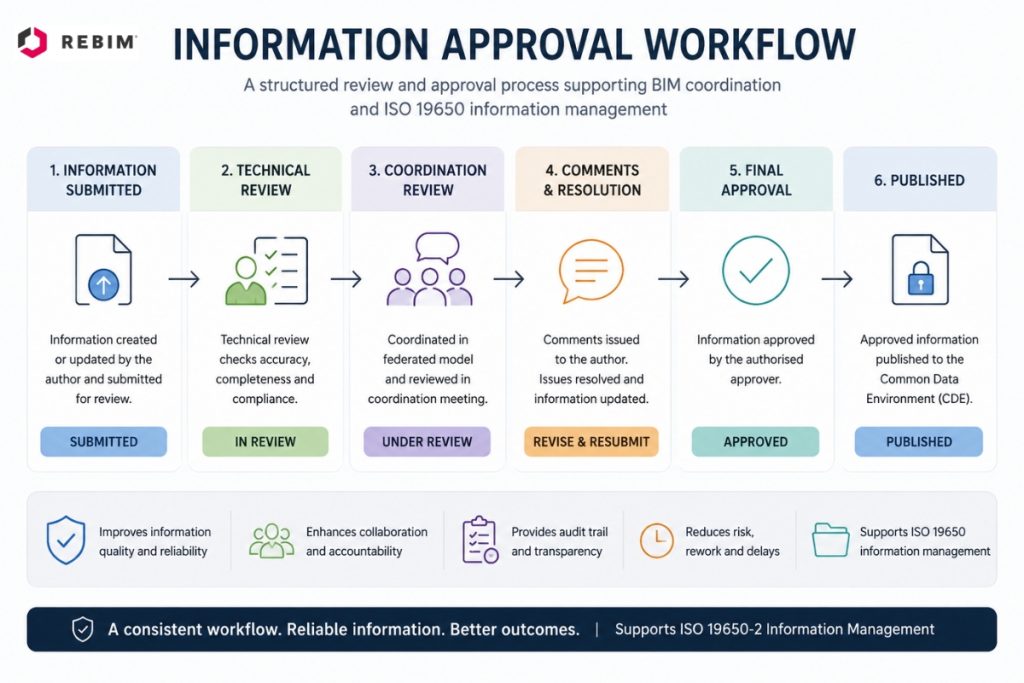
BIM coordination is one of the most important processes in modern construction project delivery. Effective BIM coordination helps project teams improve collaboration, reduce design clashes, manage information more effectively and deliver more predictable project outcomes across the full asset lifecycle. BIM coordination meetings are a collaborative process where project teams review federated models, resolve design and information issues, and coordinate project delivery in real time, either in person or through digital collaboration platforms.
Editor’s note: This article has been updated to reflect the 2026 ISO 19650 terminology changes. Because much of the construction industry continues to use established BIM terminology, we refer to both the traditional and updated terms throughout this guide.
BIM coordination has also evolved alongside the latest ISO 19650 standards. While most projects still use familiar terms such as BIM Execution Plan (BEP), Employer’s Information Requirements (EIR) (now referred to as Information Production Requirements (IPR) in the 2026 ISO 19650 update) and MIDP/TIDP (now Information Production Schedule (IPS)), the 2026 update to ISO 19650 introduces new terminology that better reflects information management across the entire asset lifecycle. Throughout this article we primarily use the terms most familiar to today’s industry while highlighting the updated terminology where appropriate. For a full explanation, read our article ISO 19650 Changes Explained (2026 Update): Is BIM Being Replaced by Information Management?
As construction projects become increasingly complex, organisations need better ways to coordinate models, drawings, workflows and project information across multiple disciplines and stakeholders.
Traditionally, coordination relied heavily on meetings, spreadsheets, emails and manually reviewing drawings between disconnected teams. However, modern BIM coordination processes now use digital models, Common Data Environments (CDEs), configurable workflows and cloud-based collaboration tools to improve communication and reduce risk.
This shift is transforming how project teams deliver buildings and infrastructure projects across the architecture, engineering, construction and asset management industries.
In this guide, we explore:
- What BIM coordination is
- Why BIM coordination matters
- BIM coordination meetings and federated model reviews
- Common BIM coordination challenges
- The role of Common Data Environments (CDEs)
- Open standards and interoperability
- BIM coordination best practices
- The future of information-centric project delivery including the 2026 updates to ISO 19650
We also explore how BIM coordination increasingly extends beyond models alone into wider lifecycle information management.

What Is BIM Coordination?
BIM coordination is the process of managing and aligning project information, models, workflows and stakeholder collaboration across a construction project.
At its core, BIM coordination ensures that:
- Different disciplines can work together effectively
- Information is accurate and consistent
- Design clashes are identified early
- Teams work from approved and up-to-date information
- Project risks are reduced before construction begins
The BIM coordination process typically involves:
- Federated model reviews
- Clash detection
- Design reviews
- Issue management
- Workflow approvals
- Information exchange
- Coordination meetings
- Data validation
- Construction planning
While BIM is often associated with 3D models, effective BIM coordination extends far beyond geometry.
Modern BIM coordination increasingly includes:
- Structured information management
- Workflow management
- Mobile site reporting
- Inspection workflows
- Audit trails
- Lifecycle asset information
This reflects the wider industry shift from model-centric BIM towards connected information management across the entire asset lifecycle.
For a broader overview of BIM itself, see our guide to What Is BIM (Building Information Modelling).
Why BIM Coordination Matters
Poor BIM coordination can lead to:
- Design conflicts
- Construction delays
- Rework
- Cost overruns
- Information fragmentation
- Communication failures
- Increased project risk
On complex construction projects involving multiple consultants, contractors and subcontractors, disconnected information quickly becomes a major operational problem.
Effective BIM coordination helps organisations:
- Improve collaboration between disciplines
- Reduce clashes before construction
- Improve design quality
- Enhance accountability
- Improve reporting
- Reduce rework and delays
- Support better decision-making
- Maintain clearer audit trails
One of the biggest advantages of BIM coordination is the ability to identify problems early. When coordination issues are discovered during construction rather than during design reviews, the cost and disruption increase dramatically.
This is why BIM coordination meetings and federated model reviews have become essential parts of modern project delivery. The earlier the better…
Effective BIM coordination also improves predictability across the entire project lifecycle. When project information is structured correctly and workflows are properly managed, organisations gain much greater visibility into:
- Design progress
- Coordination status
- Outstanding issues
- Information approvals
- Site activity
- Compliance reporting
- Asset information readiness
This enables project teams to make faster and more informed decisions.
We may not think of asset owners and operators gaining much benefit from BIM coordination during the design and construct phases but it actually extends well beyond construction. Coordinated information supports:
- Better asset management
- Cleaner handover of asset information
- More reliable maintenance planning
- Improved compliance management
- Reduced operational risk
- Greater long-term data reliability
This is one of the major reasons why the industry is increasingly shifting from isolated BIM models towards wider lifecycle information management approaches.
What are the benefits of BIM coordination?
Effective BIM coordination delivers far more than clash detection. When carried out consistently throughout a project, it improves communication, reduces risk and helps ensure that accurate information is available to every project stakeholder.
As construction projects become increasingly complex, BIM coordination provides the structure needed to manage multidisciplinary teams, maintain information quality and support better decision-making throughout the asset lifecycle.
The key benefits of BIM coordination include:
Improved Collaboration
BIM coordination brings architects, engineers, contractors, consultants and clients together around a shared understanding of the project. Regular coordination meetings help resolve issues early and ensure that every discipline is working from the latest approved information.
Reduced Clashes and Rework
Federated model reviews allow design conflicts to be identified before construction begins. Detecting clashes early reduces costly rework, delays and variations during the construction phase.
Better Information Quality
A structured BIM coordination process improves the consistency, accuracy and completeness of project information. Teams work from validated data rather than isolated files, helping to reduce errors and improve confidence in decision-making.
Faster Issue Resolution
By assigning actions, tracking progress and reviewing outstanding issues during coordination meetings, project teams can resolve problems more efficiently and maintain project momentum.
Improved Compliance and Accountability
A coordinated approach creates clear audit trails for design decisions, approvals and issue resolution. This supports compliance with standards such as ISO 19650 while providing greater transparency across the project team.
Better Lifecycle Information Management
Modern BIM coordination is no longer limited to design coordination alone. It contributes to creating reliable information that supports construction, handover, operations and long-term asset management.
As organisations adopt the latest ISO 19650 information management principles, BIM coordination is becoming an essential part of maintaining accurate, connected and trustworthy information throughout the entire lifecycle of a built asset.
BIM Coordination Meetings and Federated Model Reviews
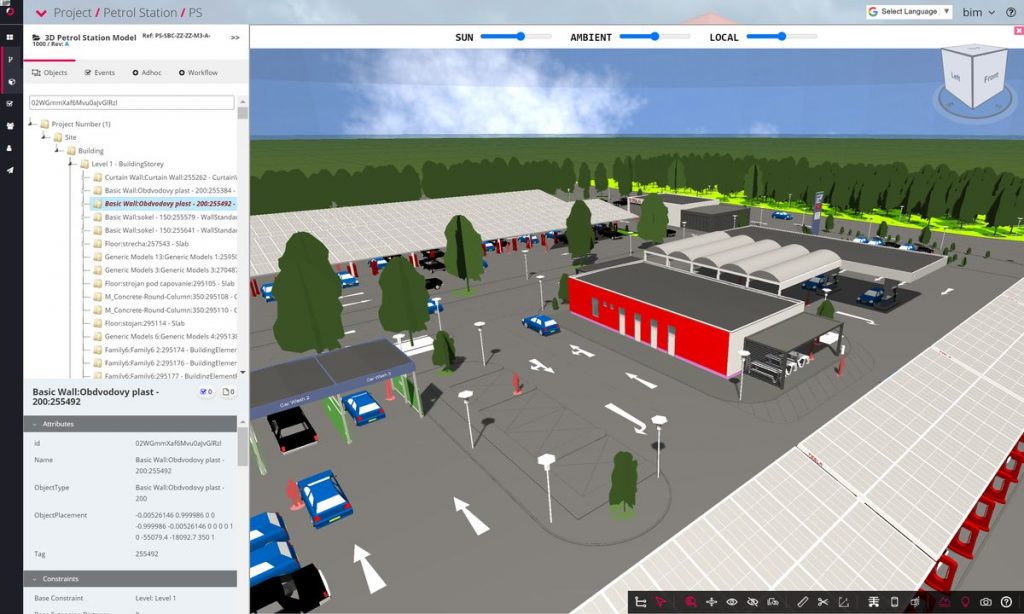
BIM coordination meetings are structured review sessions where project stakeholders collaboratively review models, drawings, workflows and project information.
These meetings typically involve:
- Architects
- Structural engineers
- MEP consultants
- Contractors
- BIM managers
- Information managers
- Project managers
- Site teams
- Specialist subcontractors
The goal is to review federated models, identify clashes, discuss coordination issues and agree actions before problems reach site.
A federated model combines multiple discipline models into a coordinated environment for review and analysis.
This allows teams to:
- Identify spatial clashes
- Review constructability
- Assess sequencing
- Validate information
- Improve communication between disciplines
- Coordinate installation activities
- Review operational constraints
Typical BIM coordination meeting activities include:
- Reviewing clash detection reports
- Tracking unresolved issues
- Reviewing design changes
- Monitoring information delivery
- Managing approvals and actions
- Coordinating construction sequencing
- Reviewing workflow progress
- Assessing project risks
- Validating design intent
Successful BIM coordination meetings require:
- Clear agendas
- Defined responsibilities
- Structured issue tracking
- Controlled information management
- Reliable model access
- Consistent workflows
- Agreed review procedures
- Action tracking and accountability
Without these controls, coordination meetings can quickly become inefficient and reactive.
One of the most common problems on construction projects is that coordination meetings become disconnected from actual workflow management. Issues may be discussed during meetings, but actions are then tracked separately through spreadsheets, emails or disconnected systems.
This creates several operational risks:
- Actions are missed
- Responsibilities become unclear
- Duplicate issues are raised
- Information becomes fragmented
- Teams lose confidence in reporting
- Decisions become difficult to audit
Modern BIM coordination increasingly requires meetings to be supported by connected digital workflows and structured issue management systems.
Many organisations are also moving towards more continuous coordination models rather than relying entirely on weekly coordination meetings. Cloud-based collaboration platforms and mobile workforce systems now allow issues, inspections and approvals to be updated in near real time.
This improves:
- Coordination visibility
- Decision-making speed
- Accountability
- Workflow consistency
- Information accuracy
Federated model reviews also play an increasingly important role in operational planning and compliance management.
Examples include:
- Fire stopping coordination
- Fire door installation reviews
- Site logistics planning
- Temporary works coordination
- Maintenance access reviews
- Safety inspections
- Asset tagging validation
As BIM coordination matures, federated model reviews are becoming less focused purely on geometry and more focused on information quality, workflows and lifecycle management.
See How REBIM Supports Modern BIM Coordination
Modern BIM coordination requires more than federated models and clash detection. It also depends on structured information management, configurable workflows, mobile workforce management and a secure Common Data Environment (CDE).
Discover how REBIM combines these capabilities within a single connected platform to improve collaboration, issue management and lifecycle information control.
→ Explore REBIM Configurable Workflows
Common BIM Coordination Challenges
While BIM coordination offers significant advantages, many organisations still struggle with implementation.
Information Fragmentation
One of the biggest BIM coordination challenges is fragmented information spread across multiple systems.
Models, drawings, RFIs, inspections, workflows and reports are often stored in separate platforms with limited integration.
This creates:
- Duplicate information
- Version control problems
- Inconsistent reporting
- Poor visibility across projects
- Delays in approvals
- Disconnected audit trails
Maintaining a true single source of truth becomes extremely difficult.
This problem becomes even more significant during the operational phase of an asset when maintenance teams, compliance teams and contractors all require access to reliable information.
Lack of Standardisation
Different teams often use different:
- Naming conventions
- Data structures
- Approval workflows
- File standards
- Reporting methods
- Workflow stages
Without standardisation, BIM coordination becomes inconsistent and difficult to scale across projects.
Even relatively simple differences in naming conventions or approval procedures can create major coordination problems on large projects.
Interoperability Problems
Construction projects frequently involve multiple software platforms.
Even with open standards such as IFC, organisations may still experience:
- Data loss during transfers
- Inconsistent model behaviour
- Poor workflow integration
- Manual reconciliation effort
- Duplicate information entry
This slows down the BIM coordination process and increases operational risk.
Resistance to Change
Successful BIM coordination requires more than software implementation.
It often involves significant changes to:
- Organisational culture
- Communication methods
- Project workflows
- Information governance
- Team responsibilities
Resistance to change remains one of the biggest barriers to BIM adoption across the industry.
Many project teams still rely heavily on:
- Email communication
- Spreadsheet tracking
- Static reports
- Manual approvals
- Isolated file storage
These traditional approaches often conflict with connected digital workflows.
Disconnected Site Workflows
A common issue is that many BIM coordination processes remain heavily office-based.
Meanwhile, site inspections, issue reporting, snagging and operational workflows often happen separately using:
- Emails
- Spreadsheets
- Messaging apps
- Standalone workflow tools
This disconnect reduces visibility and weakens lifecycle information management.
For example:
- Site issues may never be linked back to the federated model IFC
- Inspection evidence may be stored separately from project records
- Workflow approvals may lack proper audit trails
- Operational data may never feed into the Asset Information Model (AIM)
This is one of the major reasons why many organisations are now investing in connected workflow platforms that integrate operational workflows directly into the wider information environment.
In practice, we often see organisations with excellent BIM models still relying on email, spreadsheets and disconnected site applications to manage inspections, approvals and issue resolution. This creates information silos that reduce the value of the BIM process itself.
BIM Coordination Workflows and Issue Management
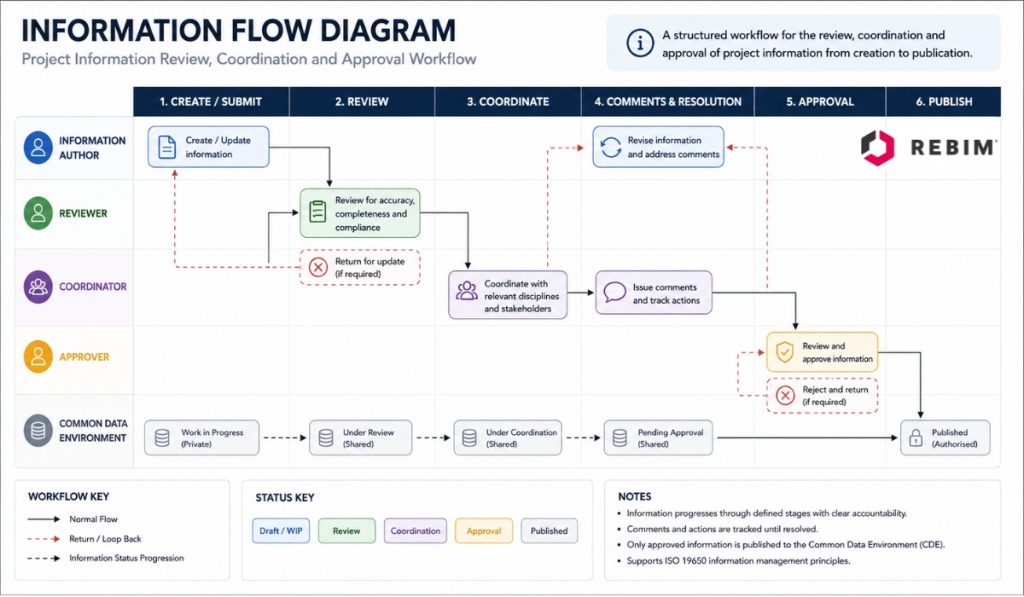
Effective BIM coordination relies heavily on structured issue management and workflow control.
Typical BIM coordination workflows include:
- Design approvals
- Requests for Information (RFIs)
- Clash resolution workflows
- Site inspections
- Defect management
- Safety workflows
- Installation inspections
- Compliance reporting
- Maintenance workflows
- Asset inspections
- Handover approvals
Managing these workflows effectively is critical for maintaining information quality and accountability.
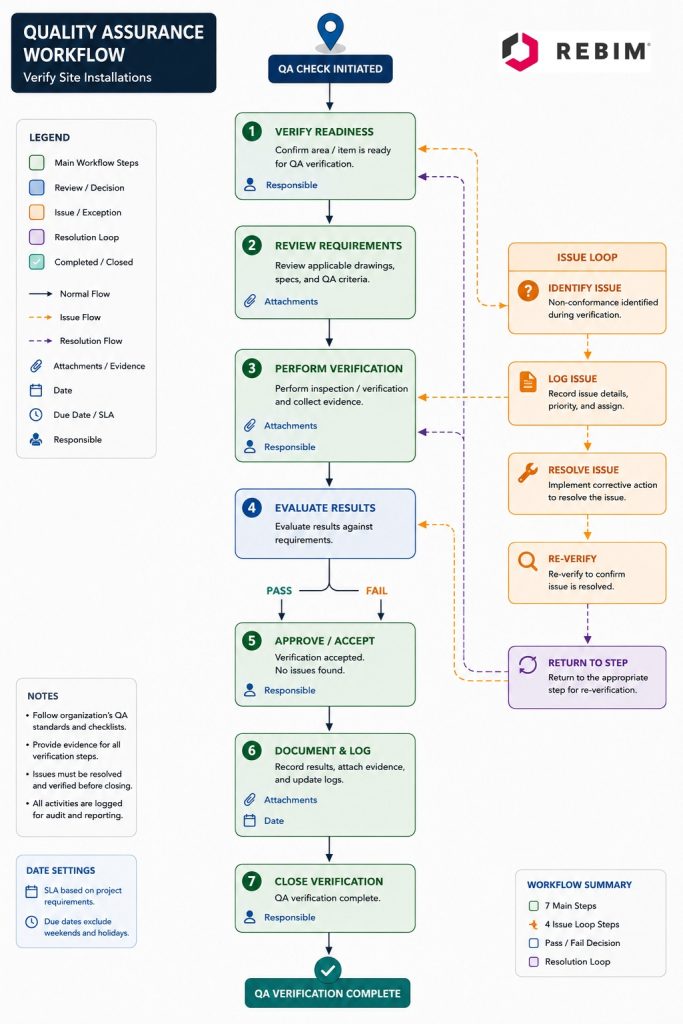
Modern configurable workflow systems help organisations:
- Standardise processes
- Enforce approvals
- Capture evidence
- Track responsibilities
- Maintain audit trails
- Improve reporting consistency
- Reduce manual administration
- Improve compliance visibility
Importantly, BIM coordination increasingly requires workflows that connect:
- Office teams
- Design teams
- Site teams
- Asset operators
- Contractors
- Supply chain partners
This is where connected workflow platforms and mobile workforce management systems become increasingly important.
Traditional issue management processes often rely heavily on spreadsheets and email chains. However, these approaches create major limitations:
- Poor visibility of issue status
- Lack of accountability
- Duplicate issue reporting
- Limited auditability
- Delayed responses
- Difficult reporting
Modern workflow-based BIM coordination enables issues to move through controlled workflow stages with:
- Assigned responsibilities
- Role-based approvals
- Attached evidence
- Real-time updates
- Full history tracking
This significantly improves coordination efficiency.
Examples of operational workflows that now commonly form part of BIM coordination include:
- Fire door installation inspections
- Fire stopping inspections
- Safety inspections
- Quality assurance checks
- Remedial works
- Planned maintenance
- Reactive maintenance
- Snagging workflows
- Site walkarounds
Many of these workflows are highly mobile-first processes carried out directly from site using phones or tablets.
This is where BIM coordination increasingly overlaps with:
- Mobile workforce management
- Configurable workflows
- Operational information management
- Asset lifecycle management
As a result, the distinction between BIM coordination and wider information management continues to reduce.
For a deeper look at this topic, see our guide to CDE vs Mobile Workflow Apps: Why Construction Companies Use Both.
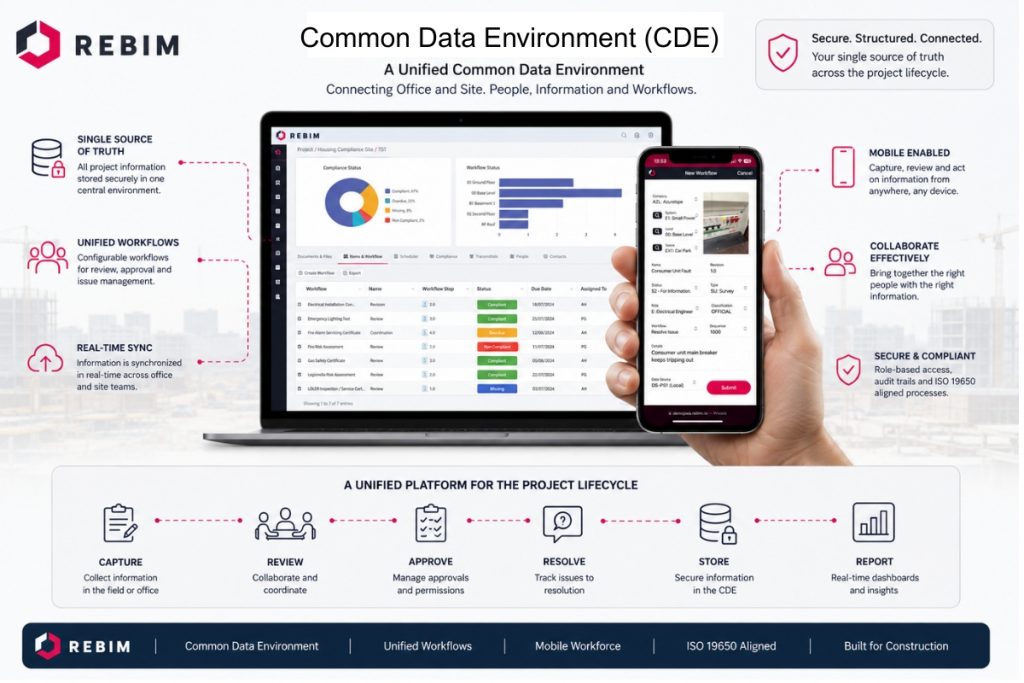
The Role of Common Data Environments in BIM Coordination
A Common Data Environment (CDE) is one of the most important foundations of effective BIM coordination.
A CDE provides a centralised environment for managing:
- Drawings
- Documents
- Models
- Project information
- Approvals
- Audit trails
The purpose of a CDE is to ensure that project teams work from controlled, approved information.
In modern BIM coordination, the CDE acts as the central information hub for:
- Collaboration
- Information governance
- Workflow control
- Reporting
- Lifecycle information management
Strong CDE implementation improves:
- Version control
- Information visibility
- Coordination efficiency
- Accountability
- Compliance
However, many traditional CDE platforms focus primarily on document management rather than operational workflows.
This is why many organisations supplement their CDE with:
- Mobile workflow apps
- Inspection tools
- Site reporting systems
- Operational workflow platforms
Increasingly, organisations are moving towards unified systems that combine both structured information management and configurable workflows within a single environment.
Open Standards and Interoperability in BIM Coordination
Open standards play a major role in modern BIM coordination.
Because construction projects involve multiple software platforms, interoperability is essential for reliable information exchange.
Key open standards include:
IFC (Industry Foundation Classes)
IFC enables model information to be exchanged between different BIM platforms.
It supports:
- Model coordination
- Information exchange
- Predictable and standardised information
- Long-term data accessibility
- Vendor-neutral collaboration
IFC remains one of the most important standards for BIM coordination and openBIM workflows.
IDS (Information Delivery Specification)
IDS helps define what information should be delivered at different project stages.
This improves:
- Information quality
- Data consistency
- Validation processes
- Project requirements management
BCF (BIM Collaboration Format)
BIM Collaboration Format (BCF) is commonly used within the industry for issue tracking and coordination workflows linked to BIM models.
It allows project teams to communicate issues and comments associated with model views without exchanging full model files.
However, in practice, many organisations still rely on broader workflow and issue management systems rather than dedicated BCF-based workflows alone.
The wider goal of interoperability is not simply file exchange.
It is enabling connected, reliable and structured information management across the entire project lifecycle.
BIM Coordination Best Practices
Successful BIM coordination requires a combination of:
- Technology
- Governance
- Standardisation
- Collaboration
- Clear workflows
Key BIM coordination best practices include:
Establish a Clear BIM Execution Plan (BEP) or Information Production Plan (IPP)
Traditionally, BIM projects have been governed using a BIM Execution Plan (BEP), which defines how information is created, shared, reviewed and approved throughout the project.
Under the draft 2026 revisions to ISO 19650, the BEP is proposed to be replaced by the Information Production Plan (IPP) as part of the wider move from BIM terminology towards Information Management. However, because the industry is still transitioning, the term BEP remains the most widely recognised and is still commonly used across projects today.
A BIM Execution Plan (now IPP) should define:
- Roles and responsibilities
- Information exchange protocols
- Coordination workflows
- Approval processes
- Model standards
- Review procedures
The BEP (now IPP) should remain a living document throughout the project lifecycle.
ISO 19650 Terminology Changes (2026)
The 2026 revision of ISO 19650 shifts the language of BIM towards broader Information Management terminology. During the transition period many organisations will continue using the traditional terminology, so it is important to understand both.
| Previous terminology | 2026 terminology |
|---|---|
| BIM | Information Management (IM) |
| Employer’s Information Requirements (EIR) | Information Production Requirements (IPR) |
| BIM Execution Plan (BEP) | Information Production Plan (IPP) |
| MIDP / TIDP | Information Production Schedule (IPS) |
Although many organisations still use the traditional terminology today, the updated terminology will become increasingly common as clients adopt the latest ISO 19650 guidance.
For a detailed explanation of these changes, read our article:
ISO 19650 Changes Explained (2026 Update): Is BIM Being Replaced by Information Management?
Standardise Information Structures
Consistency improves coordination efficiency.
This includes:
- Naming conventions
- File structures
- Workflow stages
- Approval procedures
- Reporting standards
Use Structured Coordination Meetings
BIM coordination meetings should:
- Follow a clear agenda
- Focus on actionable issues
- Use controlled information
- Track responsibilities
- Maintain clear audit trails
Improve Workflow Integration
Disconnected workflows create fragmented information.
Modern BIM coordination increasingly benefits from connected systems that combine:
- Document control
- Workflow management
- Mobile reporting
- Inspection processes
- Lifecycle information management
Prioritise Lifecycle Information Management
Projects should not treat information handover as the end goal.
Instead, BIM coordination should support:
- Operations
- Maintenance
- Asset management
- Compliance
- Long-term performance
This reflects the industry’s broader move towards lifecycle-focused information management.

The Future of BIM Coordination and Information Management
The proposed 2026 ISO 19650 revisions reinforce many of the principles discussed throughout this guide. Although terminology is evolving from BIM towards Information Management, effective BIM coordination remains fundamental to delivering high-quality project information. The focus is no longer simply on coordinating models, but on coordinating reliable information throughout the entire asset lifecycle.
The future of BIM coordination is increasingly centred around connected information ecosystems rather than isolated models.
Construction projects are becoming more:
- Data-driven
- Cloud-connected
- Workflow-integrated
- Lifecycle-focused
Emerging technologies such as:
- Digital twins
- IoT
- AI-driven analytics
- Real-time reporting
- Automated workflows
are all expanding the role of BIM coordination.
At the same time, industry standards such as ISO 19650 are evolving towards broader information management approaches across the full asset lifecycle.
This represents a major shift:
- from file-based coordination
- towards structured information management
As a result, BIM coordination is becoming less about individual software tools and more about:
- connected workflows
- reliable information
- governance
- collaboration
- lifecycle performance

Conclusion: BIM Coordination Is Becoming Information Management
BIM coordination has become one of the most important disciplines in modern construction project delivery. When carried out effectively, it improves collaboration, increases information quality, reduces rework, strengthens accountability and provides a reliable foundation for the entire project lifecycle.
Successful BIM coordination depends on far more than federated models and clash detection. It requires clear information requirements, consistent standards, structured review processes, effective communication and a Common Data Environment that enables every project participant to work from the same trusted information.
The proposed 2026 updates to ISO 19650 reinforce this wider approach. Rather than focusing solely on Building Information Modelling, the standard increasingly emphasises Information Management across the complete asset lifecycle. While familiar terms such as BIM Execution Plan (BEP), Employer’s Information Requirements (EIR) and MIDP/TIDP remain widely used throughout the industry, they are gradually evolving into Information Production Plan (IPP), Information Production Requirements (IPR) and Information Production Schedule (IPS). The terminology is changing, but the objective remains exactly the same: delivering the right information to the right people at the right time.
For a detailed explanation of these terminology changes and what they mean for project teams, read our article:
ISO 19650 Changes Explained (2026 Update): Is BIM Being Replaced by Information Management?
As organisations continue their digital transformation, effective BIM coordination increasingly relies on more than model management alone. Modern projects require connected information environments, configurable workflows, mobile workforce applications, real-time reporting and robust information governance working together within a secure Common Data Environment.
At REBIM®, we believe this is the future of digital project delivery. Our platform combines Common Data Environment (CDE) capabilities, configurable workflows, mobile workforce management and lifecycle information management within a single connected solution, helping organisations improve collaboration from design through construction and into long-term asset management.